
Understanding Nouns and Adjectives

Introduction
Welcome to a friendly exploration of the basic building blocks of the English language: nouns and adjectives. Whether you’re a student, a writer, or simply someone looking to polish their grammar skills, understanding these parts of speech is essential. Nouns and adjectives are the cornerstones of vivid and precise communication.
Interactive Lesson Plan: Singular & Plural Nouns
1. Warm-Up Activities from the picture
- Show one of the singular pictures (e.g., one cow).
- Ask:
- “What do you see?”
- Encourage answers: “A cow.”
- Then show the plural version.
- Ask:
- “And now? One or many?”
- Write both on the board: “one cow” → “many cows.”
- Highlight the ending -s.
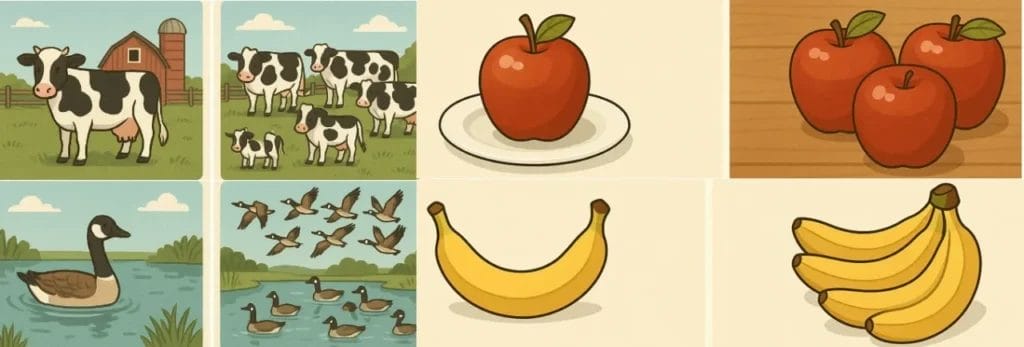
2. Singular vs. Plural Sorting
Activity:
- Show panels one at a time.
- Students answer:
- “One goose.” / “Many geese.”
- Write their answers on the board in two columns: Singular vs. Plural.
- Circle irregular forms (goose → geese, child → children).
3. Identify and Say
- Show each panel one by one.
- Ask students: “What do you see?”
- They respond: “One apple” / “Three apples” / “One banana” / “Four bananas.”
- Helps reinforce singular vs. plural pronunciation.
4. There is / There are Practice
- Use sentence frames:
- “There is ___.”
- “There are ___.”
- Example: “There is one apple.” / “There are three apples.”
5. Sentence Building with Frames (10 minutes)
Activity:
- Write sentence frames on the board:
- “There is ___.”
- “There are ___.”
- Students take turns describing the pictures.
- Examples:
- “There is one cow.”
- “There are many cows.”
- Correct gently if they confuse is/are.
Online links to quizzes, worksheets, video lessons and presentations
Nouns and adjectives online Quizzes
Nouns and adjectives Online Quiz
Nouns and adjectives Worksheets
Nouns and adjectives Presentations
What are Nouns?
Definition and Explanation
At its simplest, a noun is a word that names a person, place, thing, or idea. Nouns are the subjects and objects of our sentences; they are the words that give our language substance and meaning.
For example:
- Cat (a thing)
- Happiness (an idea)
- City (a place)
Types of Nouns
Nouns come in various forms, each serving a unique function in our sentences. Let’s explore the main types:
Common Nouns vs. Proper Nouns
Common nouns are general names for things, people, or places. They are not capitalized unless they start a sentence.
- dog
- teacher
- city
Proper nouns, on the other hand, name specific entities and are always capitalized.
- Rover (a specific dog)
- Mr. Smith (a specific teacher)
- New York (a specific city)
Concrete Nouns vs. Abstract Nouns
Concrete nouns refer to things that can be perceived by the senses: something you can see, touch, taste, hear, or smell.
- apple
- music
- flower
Abstract nouns are intangible; they refer to concepts, ideas, or states of being.
- love
- freedom
- courage
Collective Nouns
Collective nouns denote a group of individuals or things considered as one unit.
- team
- flock
- family
What are Adjectives?
Definition and Explanation
An adjective is a word that describes or modifies a noun, providing more information about it. Adjectives add color, size, shape, and other qualities to our language, making descriptions more precise and interesting.
For example:
- Happy (describes a state of emotion)
- Blue (describes a color)
- Large (describes size)
Interactive Lesson Plan from the Picture – Adjectives

1. Warm-Up – Descriptive Adjectives
- Teacher makes a sad face, then a happy face.
- Ask: “How do I feel? Am I happy or sad?”
- Students guess.
- Repeat quickly with students acting out emotions.
2. Presentation – Picture Talk
Show each picture and guide students:
- Sad Girl → Ask: “Is she happy or sad?” → Students: “She’s sad.”
- Happy Man → Ask: “How does he feel?” → Students: “He’s happy.”
- Big Dog vs. Small Dog → Ask: “Which dog is big? Which dog is small?” → Students: “The black dog is big. The brown dog is small.”
- Red Car → Ask: “What color is the car?” → Students: “The car is red.”
Write model sentences on the board:
- “He’s happy.”
- “She’s sad.”
- “The dog is big.”
- “The dog is small.”
- “The car is red.”
3. Guided Practice – Comparative Challenge
- Show two items from the picture set (cars, houses, coffees, laptops, phones).
- Ask comparative questions:
- “Which car is faster?”
- “Which phone is newer?”
- “Which lap is thinner?”
- Students answer aloud in complete sentences.
- Teacher highlights irregular forms if they come up (e.g., good → better).
4. Interactive Team Game (15 minutes) – Sentence Building Relay
- Divide class into two teams.
- Place pictures on the board or projector.
- First student in each line runs up, chooses a picture, and writes a comparative sentence on the board.
- Example: “The Ferrari is faster than the Honda.”
- Next teammate continues with a different picture.
- Rules:
- Sentences must be correct (spelling + grammar).
- No repeating the same comparison.
- First team to finish correctly wins.
5. Pair Activity – Make Your Own Comparison
- Give each pair two random picture cards (cut from collage).
- Students create 2–3 comparative sentences together.
- Example: with “cake” and “coffee” → “The cake is bigger than the coffee.”
- Walk around to check accuracy and encourage creativity.
- Some pairs share aloud with the class.
6. Wrap-Up – Quick Fire Round
- Teacher shows rapid images one after the other.
- Students shout out comparative sentences.
- Example: (dog vs. big dog) → “The black dog is bigger than the brown dog.”
Extension / Homework
- Ask students to take photos at home (two objects, e.g., shoes, bags, cups) and write 3 comparative sentences.
- Share in the next class.
Types of Adjectives
Just like nouns, adjectives also come in various forms, each serving to describe nouns in different ways. Here are the main types:
Descriptive Adjectives
Descriptive adjectives provide information about the characteristics of a noun, such as color, size, shape, and other qualities.
- red
- tiny
- round
click here : Sample Process Paragraphs
Quantitative Adjectives
Quantitative adjectives indicate the quantity of the noun being described, whether in specific numbers or general amounts.
- some
- many
- few
Demonstrative Adjectives
Demonstrative adjectives point out specific nouns and are typically used to indicate proximity or distance.
- this
- that
- these
- those
How Nouns and Adjectives Work Together
Nouns and adjectives are partners in crime when it comes to constructing rich, evocative sentences. Adjectives modify nouns by providing additional details about them, thereby painting a clearer picture in the reader’s mind.
Consider the following sentences:
- The cat slept. (A simple sentence with a noun)
- The lazy cat slept. (Adding an adjective provides more information)
- The lazy, striped cat slept. (Multiple adjectives give an even clearer picture)
Using nouns and adjectives together effectively can elevate your writing, making it more engaging and vivid. However, it is important to use them judiciously to avoid overwhelming the reader with too many details.
Tips for Using Nouns and Adjectives Effectively in Writing
Here are some tips to help you make the most of nouns and adjectives in your writing:
Keep Descriptions Clear but Vivid
While it’s important to provide enough detail to paint a picture, clarity should always be your priority. Choose adjectives that offer specific, concrete details rather than vague or overly general ones.
The old, crumbling mansion stood atop the hill, its shadow looming over the village.
Avoid Overusing Adjectives – Quality Over Quantity
Using too many adjectives can clutter your writing and make it harder for the reader to follow. Focus on using a few well-chosen adjectives that convey the most important details.
The bright, sunny, warm, breezy day was perfect for a picnic. (Overloaded with adjectives)
The sunny day was perfect for a picnic. (Clearer and more effective)
Provide Examples Demonstrating Effective Use
Here are some examples that illustrate the effective use of nouns and adjectives together. Notice how the adjectives add depth to the description without overwhelming the reader:
- The ancient tree stood proudly in the middle of the vast field, its gnarled branches reaching towards the sky.
- She wore a beautiful dress that shimmered in the soft moonlight, its silky fabric flowing gracefully as she moved.
Fun Exercises for Practice
Now that you have a better understanding of nouns and adjectives, let’s put that knowledge to use with some fun exercises! These activities will help you practice creating sentences that use nouns and adjectives effectively.
Sentence Construction Exercises
Here are some exercises to get you started:
Create a List of Nouns and Pair Them with Fitting Adjectives
Start by making a list of nouns, then brainstorm adjectives that describe them. For example:
- Car: fast, red, old
- House: big, cozy, haunted
- Book: interesting, thick, ancient
Write Short Descriptive Paragraphs Using Varied Nouns and Adjectives
Challenge yourself to write a short paragraph that includes a variety of nouns and adjectives. Try to create a vivid scene or tell a small story. For example:
The young girl with curly hair skipped down the narrow path, her colorful dress fluttering in the gentle breeze. She carried a basket filled with fresh flowers, each petal glistening in the morning sun.
Conclusion
In this blog post, we explored the fascinating world of nouns and adjectives. We learned about the different types of nouns and adjectives, how they work together to create vivid descriptions, and tips for using them effectively in writing. By understanding and mastering these parts of speech, you can enhance your communication skills and make your writing more engaging and precise.
We encourage you to practice using nouns and adjectives in your writing. Experiment with different combinations and see how they can transform your sentences. If you have any comments, questions, or additional tips, feel free to share them in the comments section below. Happy writing!