Adjective Phrases

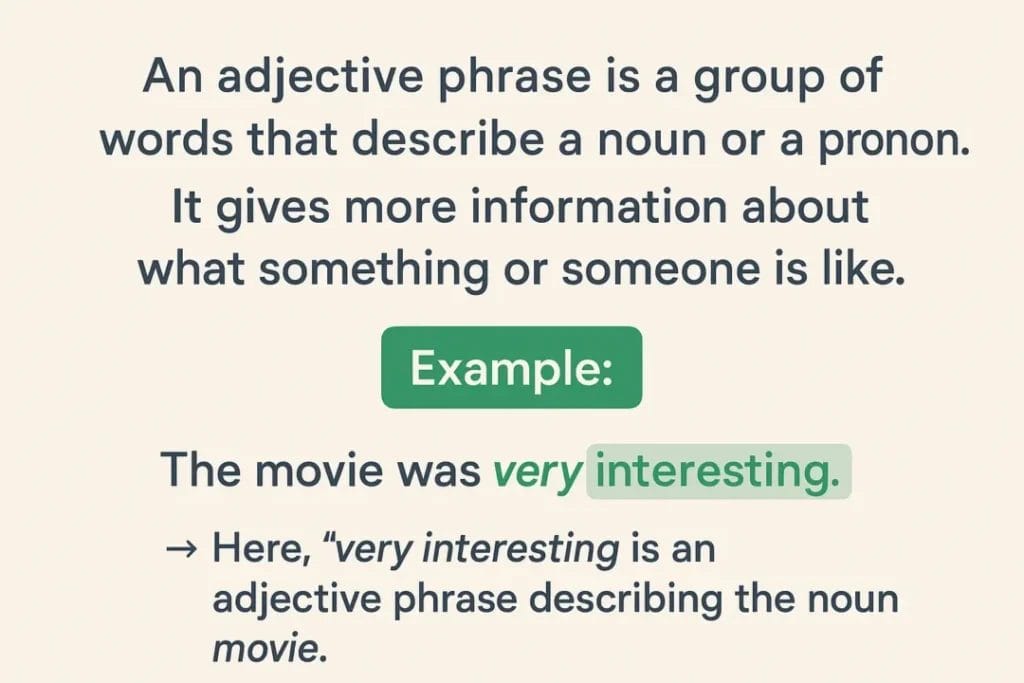
An adjective phrase is a group of words that describes a noun or a pronoun.
It provides more information or details about that noun or pronoun.
Examples with “very” (to make an adjective stronger)
Pattern: Very + Adjective
- He is very intelligent.
- The food is very delicious.
- The test was very difficult.
- I was very tired after the test.
Examples of Adjectives with Prepositional Phrases
Pattern: Adjective + Prepositional Phrase
- The man with long hair is tall.
- The book on the shelf is interesting.
- The girl with blue eyes is singing.
- We met a girl good at painting.
- A good manager must be good with people.
💡 People are usually good at a skill or good with a person or object.
Examples of Adjective Phrases
Pattern: Adjective + and + Adjective
- The kitten is small and fluffy.
- His speech was long and boring.
- Abdullah is very kind and helpful.
How Adjective Phrases help in Writing
Adjective phrases make your writing more interesting, detailed, and expressive.
Instead of using one simple adjective, they allow you to add depth and variety to your descriptions.
They make writing more descriptive
Adjective phrases give a clearer picture of what you are describing.
Example:
- Simple: The boy is smart.
- Better: The boy is very smart and confident.
The phrase “very smart and confident” helps the reader imagine the boy better.
Remember:
An adjective phrase adds detail, description, and color to your writing.
It helps readers see, feel, and understand the nouns you describe more clearly.