Finding the Main Idea of a Reading Passage
Finding the main idea is the most important part of reading comprehension. In this article, I’m going to explain how to find the main idea of a paragraph. Once you know how to find the main idea of a paragraph, you’ll be able to identify the main idea of the entire reading passage.
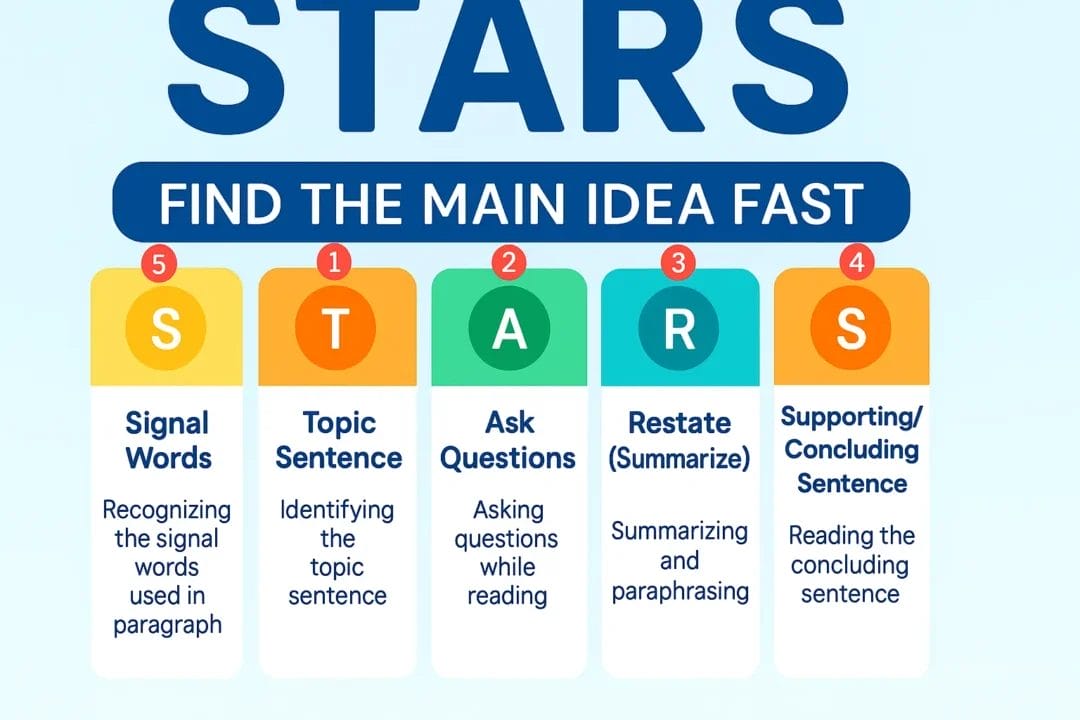
Here are the five strategies (STARS) that can help students identify the main idea of a paragraph.
1. Identifying the topic sentence
Identifying the main idea often involves locating the topic sentence, which is usually the first sentence of a paragraph. The topic sentence gives the central idea of the paragraph and sets the stage. It also acts as a guide for the reader, helping them grasp the primary focus of the paragraph. Identifying the topic sentence is crucial for grasping the main idea of a paragraph.
2. Read the concluding sentences
The concluding sentence of a paragraph serves an important role in identifying the main idea of the paragraph. It effectively summarizes the main idea discussed in the paragraph and provides a sense of closure to the reader. The concluding sentence acts as a guiding beacon, directing the reader towards the core message of the paragraph and enhancing their understanding of the content.
3. Recognizing the signal words used in the paragraph
Recognizing what signal words are used in a paragraph can greatly assist in identifying the main idea of the paragraph. Signal words such as “first,” “in conclusion,” “therefore,” “however,” and “for example” serve as cues to the reader, indicating shifts in ideas, transitions between points, and the introduction of supporting evidence. These signal words effectively guide the reader through the logical progression of the paragraph, highlighting key concepts and reinforcing the main point. Ultimately, being familiar with signal words enhances the reader’s ability to grasp the core message of the paragraph and comprehend its significance within the broader context of the text.
4. Asking Questions
One effective strategy for identifying the main idea of a paragraph is to ask yourself guiding questions while reading, such as, “What is this passage mainly about?” or “What point is the writer trying to make?”
Asking such questions enhances comprehension, improves memory, and helps you clearly recognize the central idea of the paragraph.
5. Summarizing and paraphrasing
Once you read a paragraph, you should try to summarize the content of a paragraph in your own words. This exercise can also help you identify the main idea of the paragraph.
STARS – Find the Main Idea Fast
I have created an acronym that can help you become a STAR Reader to find the main idea. The acronym is STARS.
Watch the video on Transition Words and Phrases in English to understand how signal words guide meaning in a paragraph.
Track the logical flow
Look for cues like first, however, therefore, in conclusion, for example. These transitions show how ideas connect and help identify the main idea.
Underline two or three signal words in each paragraph.
Start where the idea begins
The topic sentence, often the first sentence, introduces the central idea and gives direction for the rest of the paragraph.
If it is not first, look for a broad statement that the rest of the sentences explain.
Think actively while reading
Ask questions such as: What is this paragraph about? What question does it answer? How does it link to the previous part?
If you cannot answer easily, reread and look for clues.
Say it in your own words
Summarize the paragraph in one or two sentences. If your summary matches the main points, you have found the main idea.
Think: Subject + what the author says about it.
Confirm your understanding
Check the supporting details and the last sentence. The conclusion usually repeats or strengthens the main idea.
Ask yourself: What message does this paragraph leave me with?
How to use STARS while reading
- Look for signal words and topic sentences.
- Ask yourself questions to stay focused.
- Restate what you read and check the concluding line.
Finding the Main Ideas & Details
How to Understand Each Paragraph
Each paragraph is a building block of meaning that contributes to the overall message.
📋 Paragraph Reading Strategy
- Focus on headings/subheadings: Use them as guides
- Identify the main idea: Capture the core message
- Find supporting details: Examples • evidence • explanations
- Recognize transition words: Track relationships
- Visualize content: Create mental images
- Paraphrase: Restate in your own words
- Ask questions: Check understanding
Identify Main Ideas and Supporting Details
The main idea is the author’s most important point; supporting details provide evidence, examples, or explanations.
📊 Structure of a Paragraph:
Main Idea: “Regular exercise provides numerous health benefits.”
Supporting Detail 1: Strengthens the cardiovascular system
Supporting Detail 2: Improves mental health
Supporting Detail 3: Helps maintain healthy weight
Conclusion: Incorporating exercise into daily routines is essential
📋 Finding Main Ideas
- Check the first sentence (often topic sentence)
- Check the last sentence (may summarize)
- Ask: “What is this paragraph mostly about?”
- Identify repeated concepts or themes
- Notice which ideas get the most explanation
Recognize and Understand Transition Words
What are they? Words or phrases that link ideas and create flow. Why use them? They show relationships like addition, sequence, cause–effect, contrast, conclusion, and examples.
➕ Addition
- Moreover
- Furthermore
- Additionally
- Also
- In addition
Example: “The story is tense. Furthermore, it explores hope.”
🔢 Sequence
- First
- Next
- Then
- Finally
- Subsequently
Example: “First, a problem appears. Then, a plan forms.”
⚡ Cause & Effect
- Because
- Therefore
- As a result
- Hence
- Consequently
Example: “He rushed; therefore, he missed details.”
⚖️ Contrast
- However
- On the other hand
- Although
- Yet
- Nevertheless
Example: “The plan is clear. However, it’s risky.”
✅ Conclusion
- In conclusion
- To summarize
- Thus
- Hence
- Overall
Example: “Overall, the results support the claim.”
📝 Example/Illustration
- For example
- For instance
- Such as
- To illustrate
- Specifically
Example: “Many cities face pollution. For instance, Delhi.”
Visualize and Interpret Pictures
Visualization activates mental imagery, making content easier to understand and remember.
📋 Visualization Techniques
- Use visuals to clarify complex ideas
- Create mental images or quick sketches
- Connect visual information to written descriptions
🔬 Research Insight: Visualization Enhances Understanding
Readers who visualize key scenes or arguments retain more information over time.
Paraphrase Each Paragraph
Example Paraphrasing
Original: “The industrial revolution transformed societies by introducing mechanized production methods that increased efficiency and output.”
Paraphrase: “Machines let factories make more goods faster, changing how societies worked.”
Ask Questions After Each Paragraph
Active questioning keeps you engaged and monitors comprehension.
Essential Questions
- “What did I learn here?”
- “How does this connect to the previous paragraph?”
- “What question does this paragraph answer?”
- “Can I summarize this in one sentence?”
- “What is the author’s purpose in this section?”
💡 Pro Tip: The Pause-and-Process Strategy
After every 2–3 paragraphs, pause 10 seconds to summarize and predict what’s next.
Strategies to help students find the main idea
Teaching students to use the five strategies
The five strategies that have been described above should be taught in the classroom. Teaching these strategies can help students identify the main idea. By repeating and using the same strategies, students gain a clear idea of how to find the main idea.
How to improve the skill of identifying the main idea?
Practicing with different types of reading passages
Exposure to a variety of reading passages, including different genres and subjects, can enhance the skill of identifying the main idea. Practicing with diverse texts allows individuals to adapt their approach to discerning the central concept, honing their ability to identify main ideas across different contexts.
Using tools and resources to help locate the main idea
Utilizing tools such as graphic organizers, summarization techniques, and online resources that provide guidance on identifying main ideas can aid in improving this skill. These resources offer visual aids and structured methods to assist individuals in effectively locating and understanding the main idea of a passage.
FAQs
Q: What is the main idea of a reading passage?
A: The main idea of a reading passage is the point or message that the author is trying to convey to the reader. It is the central idea or main topic of the longer text and is usually found in every paragraph.
Q: How can I find the main idea of a text?
A: To find the main idea of a text, it is important to understand the structure of the text and to look for the idea expressed in the entire passage, as well as in each paragraph. You can also ask questions about the text to help discover the main idea.
Q: Why is it important to identify the main idea of a reading passage?
A: Identifying the main idea helps readers to understand the overarching idea of the passage, and it allows readers to comprehend the author’s purpose in writing the text. It also enhances students’ overall comprehension and retention of the reading material.
Q: How do I figure out the main idea of a paragraph?
A: To figure out the main idea of a paragraph, focus on the sentences that provide the most important information. Look for the sentence that gives a clear idea of what the paragraph is about and relates to the main idea of the entire passage.
Q: Where is the main idea usually found in a reading passage?
A: The main idea is usually found at the beginning or end of a paragraph, or it may be stated directly in the opening or closing sentences. It is often the first or last sentence of a paragraph.
Q: How can I teach students to identify the main idea of a reading passage?
A: Teach students how to find the main idea by showing them the process of reading the passage, understanding the structure of the text, and asking questions about the text. Encourage them to look for the main idea in every paragraph.
Q: What are some strategies for understanding a text’s main idea?
A: Some strategies for understanding a text’s main idea include analyzing the text’s structure, identifying keywords and repeated phrases, and summarizing the main points of each paragraph. These strategies help in uncovering the main idea of the passage.
Q: Is the main idea of any reading passage often related to the first sentence?
A: While the main idea of a reading passage can be related to the first sentence, it is not always the case. The main idea can be found anywhere in the passage, including the middle or end of the text.
Q: What are effective ways to help students find the main idea of a reading passage?
A: Effective ways to help students find the main idea include guiding them to look for the topic sentence in each paragraph, teaching them to identify the supporting details, and encouraging them to summarize the main idea in their own words.
Q: Can the main idea of a text be related to the author’s purpose?
A: Yes, the main idea of a text is often related to the author’s purpose. Understanding the main idea gives readers insight into what the author is trying to convey and helps them to recognize the purpose behind the writing of the passage.