Reading Skills Framework: Proven Strategies to Boost Comprehension

In this reading skills framework, I have tried to share strategies that are useful for students from the primary to the advanced level. By using this framework, you can improve your comprehension and retention skills. Reading is a skill that can be developed through practice.
If you apply the techniques I’ve shared here step by step, these tips and strategies will eventually become second nature to you.
Reading Skills : Difference between Consumption and Digestion
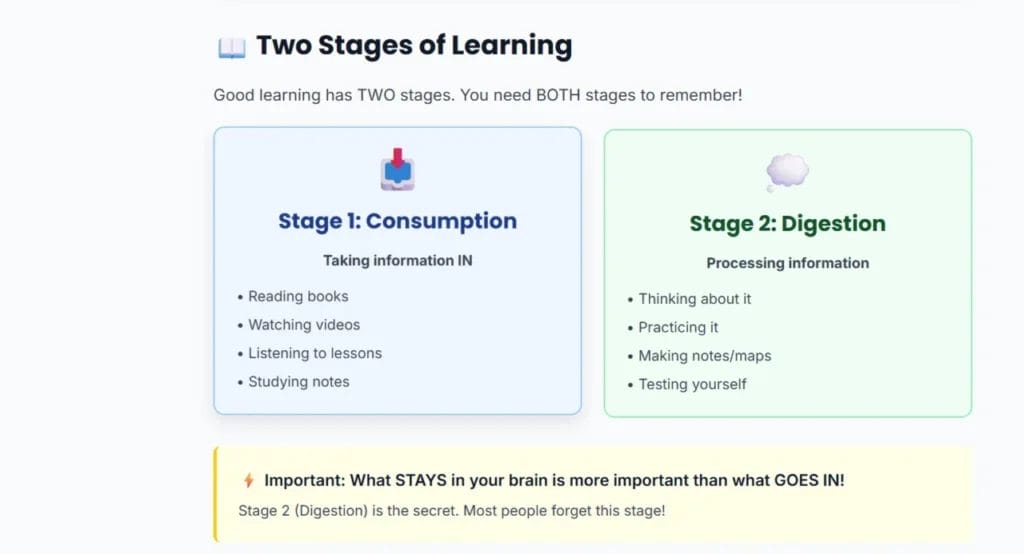
However, I want to tell you something very important: whenever you learn something, there are two stages of learning. The first stage is consumption, which happens when you read and take in information. The second stage is digestion, when you process and understand what you have read.
Through the picture given below, I have tried to explain what consumption and digestion mean in the learning process. So, if you truly want to remember what you study, don’t just consume information , make sure to digest it as well. That’s how real learning and long-term memory happen.
The reading framework I am providing you is a structured, research-backed approach to developing exceptional reading comprehension skills. Reading is not just about recognizing words. In fact, it’s about understanding, analyzing, and retaining information. Whether you’re reading novels, essays, academic texts, or articles, this guide will help you become a strategic and effective reader who truly comprehends and remembers what you read.
Pre-Reading Activities
The Three Essential Pre-Reading Steps
Before diving into reading, effective readers preview the text to activate their background knowledge and set clear expectations. These three steps guide your pre-reading preparation:
📌 Title
Predict topic & theme
📑 Headings & Subheadings
Skim structure & flow
🖼️ Pictures & Visuals
Use images to activate prior knowledge
Understand the Title
The title is your first clue about the content. Use it strategically to prepare your mind for what’s ahead.
📋 Title Analysis Checklist
- Predict the topic and theme of the text
- Connect the title to your prior knowledge
- Generate questions you expect the text to answer
- Consider the text type (narrative, expository, persuasive)
- Predict the author’s purpose
Example Title Analysis:
- Title: “The Impact of Social Media on Modern Communication”
- Prediction: It will discuss how social media changed communication
- Prior knowledge: Platforms like Facebook, Instagram, Twitter
- Questions: Positives/negatives? Changes to face-to-face communication?
Analyze Headings and Subheadings
Headings and subheadings are like signposts—they guide you through the text and reveal its organizational structure.
📋 Heading Analysis Strategies
- Skim all headings/subheadings for an overview
- Identify organization: chronological, cause–effect, compare–contrast, problem–solution
- Notice how ideas are grouped and sequenced
- Use headings to create a mental outline
- Predict each section’s main idea
⏰ Chronological
Events organized by time sequence
- Early Years (1990–2000)
- Growth (2001–2010)
- Modern Era (2011–Present)
🔄 Cause-Effect
Actions and results
- Causes
- Effects
- Solutions & Outcomes
⚖️ Compare-Contrast
Similarities and differences
- Traditional Education
- Online Learning
- Key Differences
💡 Problem-Solution
Issues and answers
- The Challenge
- Current Approaches
- Recommended Solutions
Observe Pictures and Visuals
Visual elements provide context, clarify complex ideas, and help you understand key points before reading.
📋 Visual Analysis Questions
- What do these visuals suggest about the content?
- How do they connect to the title or headings?
- What information do charts/graphs provide?
- Do images show important people, places, or events?
- How do captions add meaning?
Activate Prior Knowledge
Connecting new information to what you already know creates mental hooks that improve comprehension and retention.
Activation Questions:
- “Have I read something similar before?”
- “What do I know about this subject?”
- “Have I experienced anything related to this topic?”
- “What related vocabulary am I familiar with?”
- “What questions do I have about this topic?”
Set Clear Objectives
Decide what you want to learn or achieve by reading. Clear goals focus your attention and improve comprehension.
Example Reading Objectives:
- “Understand the author’s argument”
- “Identify three causes of the problem discussed”
- “Read for enjoyment and follow the plot”
- “Learn new vocabulary related to this topic”
- “Find specific information to answer my questions”
💡 Pro Tip: The 3-Minute Preview
Analyze the title, scan headings, look at visuals, and set one goal. This brief preview can significantly improve focus and comprehension.
While Reading Activities
How to Understand Each Paragraph
Effective reading happens paragraph by paragraph. Each paragraph is a building block of meaning that contributes to the overall message.
📋 Paragraph Reading Strategy
- Focus on headings/subheadings: Use them as guides
- Identify the main idea: Capture the core message
- Find supporting details: Examples/evidence/explanations
- Recognize transition words: Track relationships
- Visualize content: Create mental images
- Paraphrase: Restate in your own words
- Ask questions: Check understanding
Identify Main Ideas and Supporting Details
The main idea is the most important point the author wants to convey. Supporting details provide evidence, examples, or explanations.
📊 Structure of a Paragraph:
Main Idea: “Regular exercise provides numerous health benefits.”
Supporting Detail 1: Exercise strengthens the cardiovascular system
Supporting Detail 2: Physical activity improves mental health
Supporting Detail 3: Regular movement helps maintain healthy weight
Conclusion: Therefore, incorporating exercise into daily routines is essential
📋 Finding Main Ideas
- Check the first sentence (often the topic sentence)
- Check the last sentence (may summarize)
- Ask: “What is this paragraph mostly about?”
- Identify repeated concepts or themes
- Notice which ideas get the most explanation
Recognize and Understand Transition Words
What are they? Words/phrases that link ideas and create flow. Why use them? They show relations like addition, sequence, cause–effect, contrast, conclusion, and examples.
➕ Addition
Purpose: Add information
- Moreover
- Furthermore
- Additionally
- Also
- In addition
🔢 Sequence
Purpose: Order of ideas
- First
- Next
- Then
- Finally
- Subsequently
⚡ Cause and Effect
Purpose: Why/result
- Because
- Therefore
- As a result
- Hence
- Consequently
⚖️ Contrast
Purpose: Differences
- However
- On the other hand
- Although
- Yet
- Nevertheless
✅ Conclusion
Purpose: Sum up
- In conclusion
- To summarize
- Thus
- Hence
- Overall
📝 Example/Illustration
Purpose: Provide examples
- For example
- For instance
- Such as
- To illustrate
- Specifically
Visualize and Interpret Pictures
Visualization activates mental imagery, making content easier to understand and remember.
📋 Visualization Techniques
- Use visuals in the text to clarify complex ideas
- Create mental images or quick sketches
- Connect visual information to written descriptions
🔬 Research Insight: Visualization Enhances Understanding
Readers who visualize key scenes or arguments retain more information over time.
Paraphrase Each Paragraph
Example Paraphrasing:
Original: “The industrial revolution transformed societies by introducing mechanized production methods that increased efficiency and output.”
Paraphrase: “Machines let factories make more goods faster, changing how societies worked.”
Ask Questions After Each Paragraph
Active questioning keeps you engaged and monitors your comprehension.
Essential Questions:
- “What did I learn here?”
- “How does this connect to the previous paragraph?”
- “What question does this paragraph answer?”
- “Can I summarize this in one sentence?”
- “What is the author’s purpose in this section?”
💡 Pro Tip: The Pause-and-Process Strategy
After every 2–3 paragraphs, pause 10 seconds to summarize and predict what’s next.
Vocabulary & Grammar Mastery
Building Your Reading Vocabulary
A strong vocabulary is essential for reading comprehension. Systematic vocabulary development improves both understanding and reading speed.
📋 Vocabulary Development Strategy
- Highlight difficult words: Underline unfamiliar words
- Use context clues: Infer meaning first
- Look up definitions: When needed
- Keep a vocabulary journal: Track & review
- Review regularly: Weekly reinforcement
Create a Vocabulary Journal
| Word | Meaning | Example Sentence | Synonyms & Antonyms |
|---|---|---|---|
| Resilient | Able to recover quickly from difficulties | “The community was resilient after the disaster.” | Syn: Strong, tough Ant: Fragile, weak |
| Comprehensive | Complete; including all elements | “The report provides a comprehensive analysis.” | Syn: Thorough, complete Ant: Incomplete, partial |
| Paradigm | A typical example or pattern | “This represents a new paradigm in education.” | Syn: Model, framework Ant: Anomaly, exception |
| Advocate | A person who publicly supports something | “She is an advocate for environmental protection.” | Syn: Supporter, champion Ant: Opponent, critic |
Grammar for Better Reading Comprehension
Understanding grammar structures helps you decode complex sentences and understand the author’s intended meaning.
📝 Sentence Structures
Simple • Compound • Complex
⏰ Verb Tenses
Track timelines
🔤 Parts of Speech
Nouns • Verbs • Adjectives • Adverbs
✏️ Punctuation
Meaning and pacing
Example Sentence Analysis:
Complex Sentence: “Although the experiment failed initially, the researchers discovered an unexpected solution that revolutionized the field.”
- Dependent clause: “Although the experiment failed initially”
- Independent clause: “the researchers discovered an unexpected solution”
- Relative clause: “that revolutionized the field”
- Key transition: “Although” shows contrast
Grammar Practice for Deeper Understanding
📋 Grammar Practice Activities
- Rewrite sentences in different structures
- Identify the subject and main verb
- Break long sentences into shorter ones
- Combine simple sentences into complex ones
💡 Pro Tip: The Context Clue Strategy
Infer meaning from context first; then verify with a dictionary if needed.
Speed Reading Techniques
Building Reading Speed While Maintaining Comprehension
Speed reading isn’t about racing—it’s about efficiency without losing understanding.
👀 Skim Through Headings and Pictures
Prime your brain for faster processing.
📦 Chunk Reading
Read groups of words, not one by one.
👆 Use a Pointer
Guide eyes; reduce regressions.
👁️ Improve Eye Movement
Fewer fixations per line.
🔇 Minimize Subvocalization
Recognize phrases quickly.
⏱️ Set Time Goals
Limit sections to build pace.
📅 Practice Daily
Even 15 minutes helps.
🎯 Expand Peripheral Vision
Process more per glance.
Speed Reading Practice Progression
📋 Progressive Speed Training
- Weeks 1–2: Eliminate regressions (use a pointer)
- Weeks 3–4: Chunk reading with 3–4 word groups
- Weeks 5–6: Reduce subvocalization
- Weeks 7–8: Combine techniques; test comprehension
🔬 Research Insight: Reading Speed and Comprehension
Average readers: ~200–250 WPM; trained readers can reach 400–700 WPM while maintaining strong comprehension.
💡 Pro Tip: The Timed Reading Challenge
Read a page normally, then immediately re-read aiming 20% faster. Gradually increase the challenge.
Self-Questioning & Monitoring
The Power of Metacognitive Questioning
Self-questioning is one of the most powerful strategies for improving reading comprehension.
Before Reading
- What do I already know?
- What do I want to learn?
- What type of text is this?
- What is my purpose?
- How much time do I have?
- Which strategies will I use?
During Reading
- Main idea here?
- How do details support it?
- Role of this heading?
- Am I understanding?
- Slow down or re-read?
- Connections to earlier sections?
- What question is answered?
After Reading
- What have I learned?
- How does it connect to prior knowledge?
- What questions remain?
- Can I summarize the main points?
- What was the author’s purpose?
- Do I agree with the viewpoint?
- How can I apply this?
Monitor Your Comprehension
Good readers continuously check their understanding and take action when comprehension breaks down.
📋 Comprehension Monitoring Strategies
- Self-check regularly: Pause each page/section
- Notice confusion: Spot breakdowns early
- Diagnose: Vocabulary? Structure? Concept?
- Fix-ups: Re-read, slow down, use context, look up words
- Adjust speed: Slow for hard parts, speed for easy parts
- Take notes: Key points & terms
Fix-Up Strategies When Comprehension Breaks Down
🔄 Re-read
Go back and read the confusing section again, more slowly.
- One sentence at a time
- Read aloud if needed
- Break complex sentences
📖 Read Ahead
Sometimes the next paragraph clarifies the current one.
- Look for examples
- Find clarifying context
- Return to fix-up
🔍 Use Context
Infer meaning from surrounding info.
- Neighboring sentences
- Visuals
- Overall topic
📝 Annotate
Write notes, questions, or summaries in margins.
- Mark confusion
- Write questions
- Summarize key points
💡 Pro Tip: “Stop-Think-Paraphrase”
Every 2–3 paragraphs, paraphrase in your own words. If you can’t, re-read.
Post-Reading Activities
Summarize the Text
Summarizing consolidates understanding and helps move information into long-term memory.
📋 Effective Summarizing Strategies
- One line per paragraph: capture main idea
- Section summaries: combine paragraph lines
- Overall summary: 3–5 sentences total
- Use your own words: avoid copying
- Main ideas only: omit minor details
- Logical order: follow the text
Example Summary Structure:
Para 1: Transformation • Para 2: Benefits • Para 3: Challenges • Overall: Balanced view
Connect Ideas to Personal Experience
Relating new information to experiences and other texts deepens understanding.
📋 Making Connections
- Text-to-Self: links to your life
- Text-to-Text: links to other readings
- Text-to-World: links to current events
- Reflection & Application
Answer Questions with Evidence
Support answers with specific examples and quotations from the text.
📋 Evidence-Based Answering
- Restate the question
- Provide specific examples/quotes
- Explain how evidence supports the claim
- Use transitions to connect ideas
Example Evidence-Based Answer:
Q: How has social media affected communication?
A: It enables instant global connectivity (“share information with thousands instantaneously”) but may reduce face-to-face interaction (“decreased by 30% among young adults”).
🔬 Research Insight: Break Reading into Sessions
Shorter intervals with breaks improve focus and retention versus marathon sessions.
💡 Pro Tip: The 24-Hour Review
Review notes within a day to dramatically improve long-term retention.
Incorporating Inspiring Quotes
Find and Reflect on Meaningful Quotes
Identify and reflect on powerful quotes to connect with deeper themes.
📋 Working with Quotes
- Highlight quotes that capture key themes
- Reflect on meaning and significance
- Relate to the text and your insights
- Use quotes to support analysis
- Memorize favorites
Inspirational Reading Quotes
“The more that you read, the more things you will know. The more that you learn, the more places you’ll go.”
“Once you learn to read, you will be forever free.”
“Reading is essential for those who seek to rise above the ordinary.”
“A reader lives a thousand lives before he dies. The man who never reads lives only one.”
“There is no friend as loyal as a book.”
“Reading is to the mind what exercise is to the body.”
Research-Based Reading Strategies
Evidence-Based Techniques for Better Reading
🔬 Active Reading Increases Retention
Annotating, note-taking, and questioning significantly improve memory and comprehension.
Application: Jot key points and questions as you read.
🔬 Visualization Enhances Understanding
Visualizing content activates mental imagery to aid recall.
Application: Draw simple diagrams or concept maps.
🔬 Spaced Repetition Improves Retention
Review at increasing intervals (1d, 3d, 1w, 1m) rather than one long session.
🔬 Pre-Reading Activation Boosts Comprehension
Link new information to existing knowledge before reading.
🔬 Interleaved Practice Strengthens Skills
Mix genres and strategies to improve transfer.
Build a Sustainable Reading Practice
📋 Daily Reading Routine (30–45 minutes)
- Pre-reading (5): Preview, activate, set goals
- Active reading (20–25): Read with strategies, take notes
- Vocabulary (5): Record/review new words
- Post-reading (5–10): Summarize, reflect, answer questions
- Weekly review (15): Review notes and vocabulary
💡 Pro Tip: The Reading Journal
Record what you read, key insights, 3–5 new words, a rating (why), and one question. Takes 3–5 minutes and boosts retention.
📚 Framework Quick Reference
Step 1: Pre-Reading
Analyze title, headings, visuals; activate prior knowledge; set objectives.
Step 2: While Reading
Main ideas, transitions, visualize, paraphrase, ask questions.
Step 3: Vocabulary & Grammar
Track new words; decode structures & punctuation.
Step 4: Speed Reading
Skim, chunk, pointer, minimize subvocalization, time goals.
Step 5: Self-Questioning
Before, during, after questions; monitor comprehension.
Step 6: Post-Reading
Summaries, connections, evidence-based answers.
Step 7: Quotes
Find, reflect, and apply meaningful quotes.
Step 8: Research-Based
Active reading, visualization, spacing, interleaving.