
Unlock 2 -Unit 3 – The internet and technology – LS – Vocabulary 1

This is Unlock 2, Unit 3, Listening and Speaking Book, Vocabulary 1. First, the teacher will teach the words from the Word List. After that, students will do the Multiple Choice and Fill Blanks activities. Once students complete these activities, they can see their scores and show them to the teacher, so the teacher knows they have finished. These activities are designed to check students’ understanding of the words in the list. If the teacher has more time, students can also complete the Flashcards, Scramble, Sentences, and Matching activities.
Vocabulary Learning
Vocabulary Word List
Review the words and meanings below before starting the activities.
Click the speaker icon or any example sentence to listen.
Connect
VerbTo join two things or places together.
Example Sentences:
- A new bridge will connect the two sides of the city.
- You can connect your phone to the speaker with a cable.
- This road will connect our village to the town.
Real World Use Case: 🔗 Connect on Youglish
Control
VerbTo limit the number, amount or increase of something.
Example Sentences:
- The government is trying to control the rising price of food.
- Teachers use rules to control the noise in the classroom.
- The city made a plan to control the number of cars in the centre.
Real World Use Case: 🔗 Control on Youglish
Device
NounA piece of equipment that is used for a particular purpose.
Example Sentences:
- A smartphone is a useful device for sending messages and taking photos.
- A tablet is a device that I use to read books and watch videos.
- He bought a small device to keep his keys from getting lost.
Real World Use Case: 🔗 Device on Youglish
Expiration date
NounThe end of a period when something can be used.
Example Sentences:
- Check the expiration date on the milk before you drink it.
- The medicine is old, and the expiration date was last month.
- Always look for the expiration date on food in the shop.
Real World Use Case: 🔗 Expiration date on Youglish
Sensor
NounA piece of equipment that can find heat, light, etc..
Example Sentences:
- The sensor turns on the light when someone walks into the room.
- A motion sensor opens the door when you come near it.
- The car has a sensor that makes a sound when you are close to a wall or another car.
Real World Use Case: 🔗 Sensor on Youglish
Waste
NounA bad use of something useful.
Example Sentences:
- Throwing away good food is a waste of money.
- Leaving the lights on all day is a waste of electricity.
- It is a waste of time to wait for the bus in the rain.
Real World Use Case: 🔗 Waste on Youglish
Accident
NounSomething bad that happens by chance, often causing injury or damage.
Example Sentences:
- He broke his arm in a bike accident.
- There was a car accident on the main road this morning.
- She was lucky because nobody was hurt in the accident.
Real World Use Case: 🔗 Accident on Youglish
Disability
NounA physical or mental condition that makes some activities difficult.
Example Sentences:
- A ramp helps people with a disability enter the building.
- People with a disability may need special help at school or work.
- The new bus has a space for passengers with a disability.
Real World Use Case: 🔗 Disability on Youglish
Look after
Phrasal verbTo take care of someone or something.
Example Sentences:
- She looks after her little brother when her parents are at work.
- I look after my neighbour’s cat when she travels.
- Parents look after their children and keep them safe.
Real World Use Case: 🔗 Look after on Youglish
Assistant
NounA person or machine that helps someone do their work.
Example Sentences:
- The robot assistant brings me water when I ask.
- The shop assistant helped me find a gift for my mother.
- My phone has a voice assistant that answers my questions.
Real World Use Case: 🔗 Assistant on Youglish
Delivers
VerbTakes something to a person or place.
Example Sentences:
- The pharmacy delivers medicine to our door.
- The postman delivers letters to our house every morning.
- This restaurant delivers hot food to your home in thirty minutes.
Real World Use Case: 🔗 Delivers on Youglish
Research
NounCareful study to find facts and learn new things.
Example Sentences:
- The students did research on how plants grow.
- Scientists do research to find new ways to stop diseases.
- I did some research online before I bought my new laptop.
Real World Use Case: 🔗 Research on Youglish
Collected
VerbGathered things or facts together from different places.
Example Sentences:
- He collected shells on the beach all morning.
- The teacher collected our homework at the end of the lesson.
- The class collected old clothes for people who needed them.
Real World Use Case: 🔗 Collected on Youglish
Information
NounFacts or details about something.
Example Sentences:
- Can you give me some information about the bus times?
- The website has useful information about the museum.
- I need more information before I make a decision.
Real World Use Case: 🔗 Information on Youglish
Developed
VerbMade or created something new, often over time.
Example Sentences:
- The engineers developed a faster way to charge phones.
- The company developed a new app for learning languages.
- Scientists developed a new medicine over many years.
Real World Use Case: 🔗 Developed on Youglish
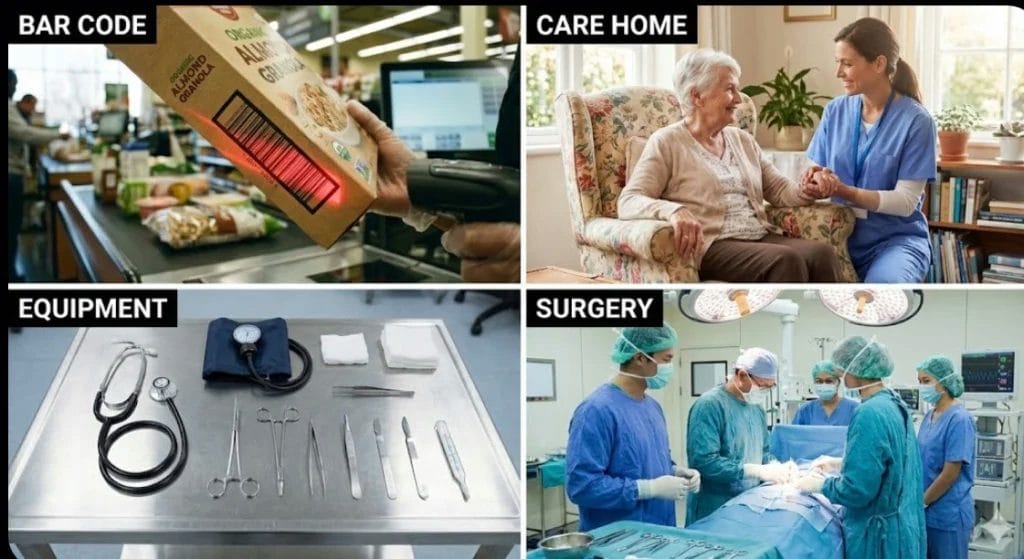
Bar code
NounA row of black lines, often on something you buy, that a computer reads to find the price or other information.
Example Sentences:
- The cashier scanned the bar code on the box to see how much it cost.
- The shop computer reads the bar code to find the price.
- Every book in the library has a bar code on the back.
Real World Use Case: 🔗 Bar code on Youglish
Care home
NounA place where somebody who is old or sick lives when they cannot live at home any more.
Example Sentences:
- My great-aunt moved into a care home where nurses help her every day.
- Her grandmother lives in a care home near the park.
- Nurses and helpers work in a care home day and night.
Real World Use Case: 🔗 Care home on Youglish
Equipment
NounThe things that are used for an activity or purpose.
Example Sentences:
- The gym has new equipment, including running machines and weights.
- The school bought new equipment for the science lab.
- You need special equipment to climb a mountain.
Real World Use Case: 🔗 Equipment on Youglish
Surgery
NounThe treatment of injuries or diseases in people or animals by cutting open the body and removing or repairing the damaged part.
Example Sentences:
- He had surgery on his knee after the football accident.
- The doctor said she needs surgery on her back.
- After the surgery, he rested in hospital for a week.
Real World Use Case: 🔗 Surgery on Youglish
Here are some engaging vocabulary activities related to the words mentioned above. These activities will reinforce the vocabulary you’ve just taught your students.
Matching – Vocabulary Quiz
In this activity, the students will match the words with their respective definitions.
Word Search – Find the hidden words in a letter Grid
In this activity, the students will search for the words that the teacher has taught. The words are hidden in a letter grid.
Spin the Wheel – Find the word
In this game, the teacher will spin a wheel, and eventually, it will stop. When the wheel stops, the students will see the meaning of a specific word. Then, the teacher will ask one of the students to guess the word by carefully reading its definition. The teacher may ask the student to make a sentence for the word.
Unscramble the word or phrase – Vocabulary Quiz
In this activity, the students will move the letters around to put them in the right order and reveal a word or phrase. All these words are connected to the above vocabulary.
Open the box
In this fun activity, the teacher will choose one of the students to participate. First, that student will pick a number. Then, the teacher will click on the chosen number. What happens next? Well, the student will see the meaning of a word—a word related to the vocabulary the teacher has taught in class. Now comes the exciting part: the student needs to read the meaning and guess the word! If the guess is correct, the teacher might even ask the student to create a sentence using that word.


